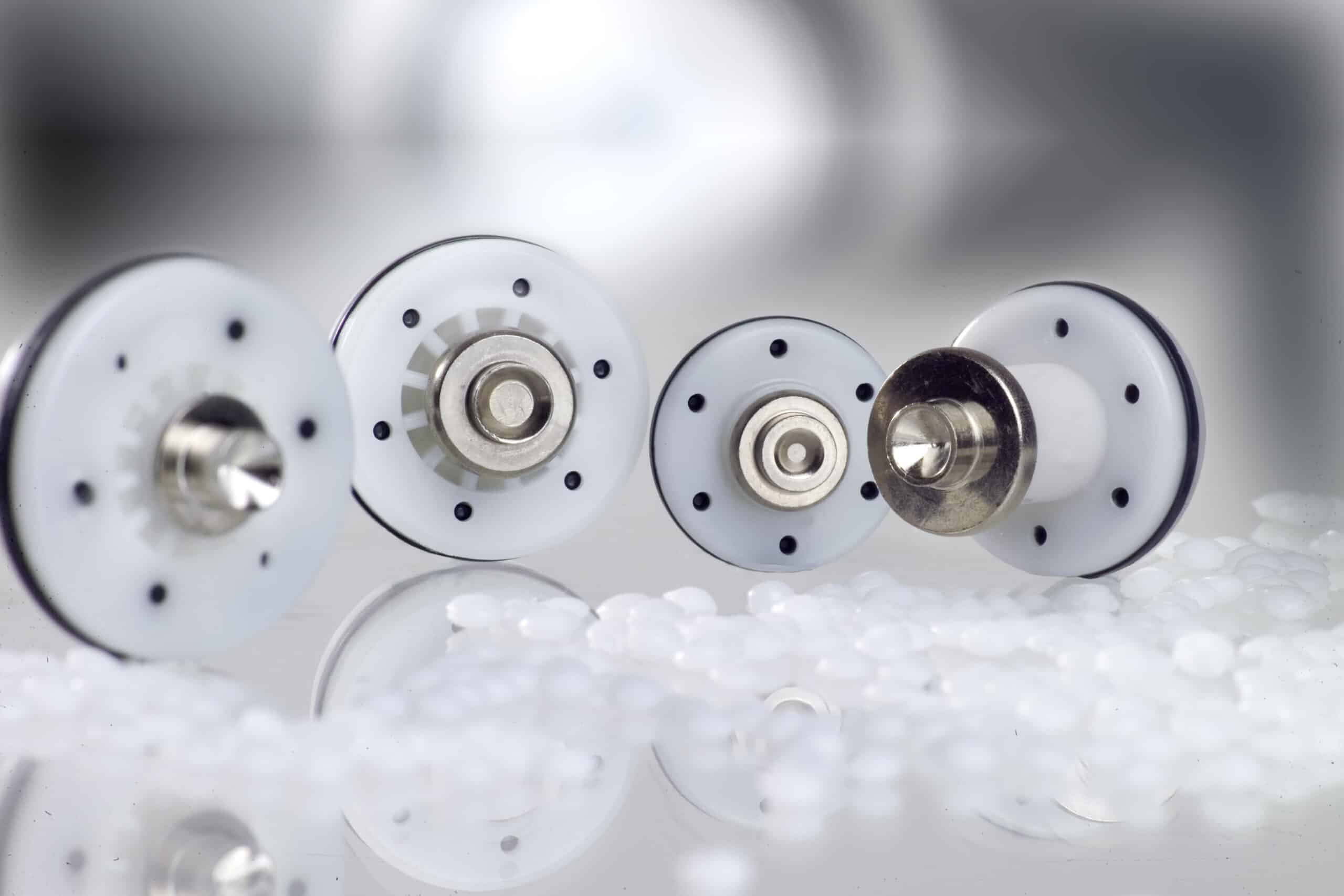
Due to the increasing market demand for low-noise rollers, the so-called soft roller was developed, which corresponds to a two-component roller. Our soft rollers reduce rolling noise to a minimum. Different versions can be overmolded on the side, in the center, or completely.
The hard core ensures optimal sliding properties on the bolt. Three specially tested materials in different hardness levels are currently available for the sheathing. Depending on the design, our soft rollers are used as load rollers or guide rollers.
With their soft coating or injection molding, the soft rollers ensure excellent running comfort. The sliding roller technology ensures low friction on the bolt, thus increasing the lifetime.
Adaptability
The soft rollers can be individually adapted to specific requirements and installation situations, offering a wide range of possible applications in different industrial sectors.
Flexible Production
Our advanced manufacturing processes allows us to offer customer-friendly prices without compromising quality.
Noise reduction
The special coating of the soft rollers reduces rolling noise to a minimum, making them ideal for use in noise-sensitive areas.
Effeciency and economic feasibility
The selection of materials for the soft roller coating is optimized to not only suit to specific customer needs, but also increase the performance and the lifetime of the rollers while remaining cost-effective.
Ready for a precise solution?
Contact us now
Learn more about our soft rollers and how they can optimize your industrial processes. Let’s work together to find the perfect solution for your requirements. Talk to one of our experts!
Soft rollers from SKT stand for customized precision and versatility in demanding applications. With flexible design options for plastic geometry, a selection of various plastics, bolt types such as screw, rivet, or socket bolts, and a diameter range from 11 to 35 mm, our soft rollers meet the highest demands for noise-reduced rolling.
Centrally or laterally injected soft rollers
With this type of soft roller, the hard core absorbs higher loads, while the overhang of the soft material effectively reduces rolling noise.
Fully overmolded soft rollers
Here, the hard core serves solely to ensure low friction on the stud. The soft sheathing ensures optimal rolling noise reduction when in contact with the profile rail.
Insert or overmold made of TPE
TPE is the short designation for thermoplastic elastomer. These plastics are available in different hardness levels, which are particularly useful for reducing rolling noise. The choice of hardness level depends on the load and the target rolling noise.
Various steel grades for the bolts
Various steels are available, such as C10C, stainless and free-cutting steels, or even brass. These can be assembled with various plastic rollers according to technical requirements.
Injected soft rollers are often used in furniture fittings as supporting rollers in various drawer or damper systems, enabling quiet and smooth opening and closing of drawers or doors. Fully overmolded soft rollers are mainly used as guide rollers for linear movements or as curve rollers in sliding doors and pocket systems.
Using of soft rollers minimizes rolling noise, which is particularly beneficial in quiet environments such as bedrooms and offices.
Fittings for building technology
In the building industry, soft rollers are primarily used as guide rollers, for example in hardware for sliding doors, windows, garage doors, and roller gates. They help ensure these elements move smoothly and quietly.
Soft rollers are also used as guide rollers in heavier-load applications such as room dividers, conservatories, or folding doors. This allows optimal smooth running in building hardware.
The low noise characteristics of soft rollers are particularly appreciated in residential and work environments where noise reduction is important.
Intralogistics and conveyor industry
In the intralogistics and conveyor Industry, soft rollers are used as guide rollers in lifting applications, shuttles, and other transport and conveyor systems. They must be able to withstand high loads and speeds over long periods of time.
They help ensure the quiet and efficient transport of goods within warehouses and production facilities. This is especially important in environments where noise reduction and gentle transport of goods are required.
Frequently Asked Questions about our soft rollers
What load capacities can soft rollers handle?
The load capacity of soft rollers primarily depends on the roller dimensions and the design of the contact surface. Due to the wide variety of options, an individual assessment is required to determine the optimal load capacity.
Are soft rollers suitable for outdoor use?
Yes, soft rollers are suitable for outdoor use. Weather-resistant materials can be used for both the pins and the plastics, ensuring they withstand outdoor conditions.
How long does the noise reduction last under heavy use?
The noise-dampening effect remains until the roller is completely worn out. However, depending on the intensity of use, wear can affect the initially high level of noise reduction.
How do soft rollers differ from conventional rollers?
Soft rollers consist of two components. The soft outer coating or overmold ensures quiet rolling, while the sliding properties are enhanced by the harder inner material as well as the combination of pins and lubricant.
How does the hardness of the material affect the performance of the roller?
Material hardness plays a key role in the roller’s performance. Depending on the application requirements, a suitable material can be selected to ensure optimal sliding properties, noise reduction, and load capacity.